Tuesday, 2 October 2012

Interpreting Scripture


The Bible has been used to oppress, enslave, judge and condemn many people over the last 2,000 years.  But it has also inspired Mother Theresa, William Wilberforce, Martin Luther King, Jnr., Desmond Tutu and many others to amazing sacrifices in the name of equality and human rights.

To some, the Bible is a list of rules and contradictions.  To others, like me, it's a book which liberates and sets us free - and introduces us to Jesus!

How can one book be read in such different ways - and which is right?  How can we read and interpret the Bible correctly?

The Book of Books
The Bible is a collection of 66 books.  39 make up the Old Testament (which is the same as the Jewish Bible, albeit in a different order) and 27 books make up the New Testament.  The Bible contains many kinds of writing, such as historical narrative (e.g. the Gospels), poetry (the Psalms), Jewish law codes (Leviticus), and apocalyptic literature (i.e. symbolic writings such as Revelation).  Being aware of the genre you are reading will help you understand and apply the Bible.  It's often mentioned that the Bible contains outrageous statements, for example, it says something about dashing children against the rocks.  This comes from Psalm 137 - a song of lament for Israel's situation.  They had been taken into captivity by the Babylonians and the writer is obviously angry.  When we read this as poetry, in its context it's impossible to read this as God sanctioning actually dashing someone's child against a rock!  

Not written in English
The Bible was written in Hebrew, Aramaic and Greek - which means most of us rely on translations into our own languages.  It's important to choose a good, yet readable translation for your main study.  It is worth comparing several translations to get closer to the original texts.  One of the verses used to say gay and lesbian relationships are wrong comes from 1 Corinthians 6:9-10 and 1 Timothy 1:9-10.  The word is ambiguous in the Greek, but you'd never know that using many English translations.  Comparing several reveals a difference in opinion, and you can then target your research to get a deeper understanding of the text.

Written in another time and culture
This point seems obvious, but it affects how we read the Bible.  The Bible was written to show us the way to God, not to answer every question we may have.  We need to be aware of Biblical cultural issues as this will help us understand what we are reading.  A good study Bible will help with this.

Letting the Bible explain itself
Sometimes we come across a verse we just don't understand.  It helps to look up other Scriptures on the same topic - many Bibles come with a concordance at the back (a bit like an index) which can help.  If you are using a study Bible it will likely have cross references which can help you interpret the verse.  You can also get a Thompson Chain Reference Bible which links topics and themes together so you can "trace" them through the Bible.

Noting the Church
It is only in recent times that we have our own personal copies of the Bible.  For almost all of Jewish and Christian history you had to go the Synagogue or Church to hear Scripture.  Biblical interpretation was a community effort, so many of our questions have been looked at in the Christian community already.  So it's worth looking into what other Christians have said about a passage before.  It's likely that at some point, someone asked the same question over the last 2,000 years!  This does not exclude new understandings of Scripture (as we've done with women, slavery, homosexuality etc) but we should be very cautious of anything that conflicts with key doctrines (the authority of Scripture, God, the Trinity, Jesus' death and resurrection, salvation by grace through faith alone, etc). I'd ignore anyone contradicting any of these.

Dealing with "contradictions"
I put contradictions in quote marks because I have yet to see an actual contradiction in the Bible.  Remember what a contradiction is.  It's two statements that cannot both be true at the same time.  If I come in to Church and tell you I met Greg outside, and then tell someone else I met Sarah, am I contradicting myself?  No.  I am presenting an inconsistency, but not a contradiction.  Why?  It's possible I met both of them outside.  If I said there was no one but Greg outside, then telling someone I met Sarah is obviously a problem.

The Bible is much the same, every "contradiction" I've ever been shown turns out to be an inconsistency - which actually bolsters the credibility of the Bible.  If we had 4 identical Gospels, people would rightly argue that the writers were getting their story straight before they wrote.  But the fact that they feel free to write something that is an inconsistency lends support to them being honest witnesses.

One last thing with contradictions.  Every person who tries to show me a contradiction always uses an English Bible.  The problem is that it's a translation!  When you go back to Greek you see that it isn't.  For example, in 2 of Paul's conversion accounts, we read that his companions heard the heavenly voice in one, and they did not hear it in the other.  In English this is a contradiction.  In Greek however it isn't.  In one, the word means to hear something audibly.  The other means to hear, as in comprehend.  Put the two together and you have the companions hearing a voice but not being able to understand it.  There is no contradiction after all.


Where to begin?
If you are new to the Bible, start with a Gospel, then maybe Romans and Galatians.  You can also get Bible reading notes to help you read a little every day, or you can be ambitious and use a reading plan to read the Bible in a year!  The best ones mix up an Old Testament reading, a New Testament reading, and a Psalm or Proverb, which keeps it interesting (especially when you get to "begats"!).


And the key thing!
The Bible was inspired by God, so we should ask for His help in understanding it.  Regular reading is important as well, as you read you'll be drawn into a divine conversation.  It's amazing how often we bring our questions to the Bible, and end up being "questioned" by it!

Finally...
I've said before, the Bible is like a billboard advertising ice cream.  You can spend a lot of time looking at the billboard, dissecting the colours, fonts, meanings and so on.  But if you never actually go and get the ice cream, you missed the whole point.  The same is true for the Bible.  Jesus once said, "You search the Scriptures because you think they give you eternal life, but the Scriptures point to me!" (John 5:39 NLT)  So don't just read the Bible, get to know Jesus for yourself!

Image: Google Images
UPDATED NOVEMBER 2017

Saturday, 25 August 2012

Bible Translations

With all the various translations of the Bible on offer, which should we be using?  I've been thinking about this quite a lot lately, after I saw a question about which translation was the best.  I've also seen the odd comment about different Bible's contradicting each other.

The first thing we need to remember is that all English Bibles are translations from Hebrew, Aramaic and Greek. This means that every translation is also, to some degree an interpretation of the Bible.  Some Christians argue that the King James Bible (KJV) is the most correct Bible.  They often point to how other translations differ from the KJV.  However the KJV is a translation like the others, and it too has its problems - not least that the English language it uses is now 400 years old.  This makes it harder to read if you are not familiar with the English language that was in use in 1611!

All Bible translations can be roughly grouped into three categories.

1.  Literal translations
Literal translations try to translate word for word as far as possible.  While this helps a modern reader to see the original structure, it can also make the text seem quite "wooden", or more difficult to read than paraphrases or Dynamic Equivalence translations. Examples include the New Revised Standard Version (NRSV), the English Standard Version (ESV) and the New American Standard Bible (NASB).

2.  Paraphrases
Paraphrases take each idea in the original and render it into English.  The most popular one today is The Message, others include The Living Bible.

3.  Dynamic Equivalence
These translations aim for literal translation but also readability.  They are generally very accurate, which makes these the most commonly used Bibles.  Examples include the New Living Translation (NLT), and the New International Version (NIV).

I would suggest that for most people, a dynamic equivalence translation should be your main Bible.  I would also strongly recommend using a translation that was done by a committee rather than an individual.  I use the NLT or NIV for most of my reading.  

If you want to get into serious study then a literal translation would be helpful.  I use the ESV as my "literal" translation. Literal translations are also better when you're speaking to Jehovah's Witnesses, for example.  Mormons use the KJV, so it's worth having one in case they call.  And every now and then, when you just want to read the Bible - The Message is great at delivering Scripture in a punchy, fun and casual way.  I also have an audio version of The Message and I love listening to it.  The only issue with The Message is that the language is very American, so non-US readers may need to get used to the language.  I would give The Message to someone who isn't used to the Bible and is reading it for the first time - especially as it translates the so called "anti-gay" verses correctly!

Which leads to another question - are any translations anti-gay, or gay friendly?  As I say, The Message is gay friendly as the translation is accurate.  And in a sense yes, some Bible translations are anti-gay, however I think this is simply due to the beliefs of the translators rather than deliberate mistranslation.  The NLT interprets arsenokoitai (1 Corinthians 6:9-10; 1 Timothy 1:9) as "practicing homosexuals" which is a bad translation.  The NIV is slightly more honest as it shows that there is some confusion in those two verses.  The 1984 edition translated one as "homosexual offenders" and the other as "perverts".  There is also a "Study New Testament For Lesbians, Gays, Bi, And Transgender" but I don't recommend it - it's not very readable and for 3 verses hardly worth it when you can do your own homework! 


One interesting version is the Amplified Bible.  There are many words in Hebrew and Greek which have many shades of meaning.  Obviously translators need to pick one, right?  Not necessarily, the Amplified Bible uses a system of punctuation and brackets to expand on the original meanings. This makes it longer to read, but you get so much more, which makes the Amplified Bible a valuable addition to your Bible study.  Have a look at Psalm 27:4 which says:

New Living Translation
The one thing I ask of the Lord the thing I seek most— is to live in the house of the Lord all the days of my life, delighting in the Lord’s perfections and meditating in his Temple.

New International Version
One thing I ask from the Lord, this only do I seek: that I may dwell in the house of the Lord all the days of my life, to gaze on the beauty of the Lord and to seek him in his temple.

Amplified Bible
One thing have I asked of the Lord, that will I seek, inquire for,and [insistently] require: that I may dwell in the house of the Lord [in His presence] all the days of my life, to behold and gaze upon the beauty [the sweet attractiveness and the delightful loveliness] of the Lord and to meditate, consider, and inquire in His temple.

Talking of Bibles, there are some to avoid.  The Jehovah's Witnesses have their own Bible known as the New World Translation.  It's a doctored version of the Bible designed to support JW teachings, especially on the nature of who Jesus is.  It should not be used by any Christian for any purpose other than discussion with the Jehovah's Witnesses, and even then, you must have your own Bible on hand as many of the corruptions in the New World Translation are very subtle.

You can read different translations at Bible Gateway. Whichever translation you choose, read it regularly, asking the Holy Spirit to open your heart and mind, and to help you understand what he has to say to you through the Bible.

Personally, I would recommend the NIV or NLT as your "day to day" Bible, and compare them with the ESV for more serious study.  Here is how these 3 versions render a few different passages as examples.

Revelation 3:20

New International Version
Here I am! I stand at the door and knock. If anyone hears my voice and opens the door, I will come in and eat with that person, and they with me.

New Living Translation
Look! I stand at the door and knock. If you hear my voice and open the door, I will come in, and we will share a meal together as friends.

English Standard Version
Behold, I stand at the door and knock. If anyone hears my voice and opens the door, I will come in to him and eat with him, and he with me.

Note, the ESV literally translates "him".  The NIV and NLT both use inclusive language as this refers to men and women.  The ESV brings out that literalness, that you wouldn't get in the NIV and NLT.

Romans 3:25

New International Version
God presented Christ as a sacrifice of atonement,through the shedding of his blood—to be received by faith. He did this to demonstrate his righteousness, because in his forbearance he had left the sins committed beforehand unpunished

New Living Translation
For God presented Jesus as the sacrifice for sin. People are made right with God when they believe that Jesus sacrificed his life, shedding his blood. This sacrifice shows that God was being fair when he held back and did not punish those who sinned in times past,

English Standard Version
whom God put forward as a propitiation by his blood, to be received by faith. This was to show God's righteousness, because in his divine forbearance he had passed over former sins.

You can see the NIV and NLT both translate the thought, though you can see the NIV is more literal than the NLT.  The ESV literally translates the words.


Image: Google Images

Friday, 3 August 2012


This is really funny - it's over an hour long but really worth it.  

Monday, 4 June 2012

Trinity Sunday

Last Sunday was Trinity Sunday.  Coming from a Baptist background, a day for the Trinity was a new concept to me.  


Although the Bible never uses the term "Trinity", the concept is clearly taught throughout the Bible.  While it insists that there is only one God, it refers to Jesus, the Father and the Holy Spirit as God.  Each is seen to be a distinct personality, co-existent with each other.  

There is no single verse which explains the Trinity.  However the Bible is fascinating.  For example, in Isaiah we are repeatedly told there is only one saviour - God.  Then in the book of Titus we are given "God our Saviour" and "Christ our Saviour" interchangeably.  And then the statement, "We should live in this evil world with wisdom, righteousness, and devotion to God, while we look forward with hope to that wonderful day when the glory of our great God and Savior, Jesus Christ, will be revealed" (Titus 2:12-13).

Jonathan Sarfati explains:

  • There is only one God (Deuteronomy 6:4, Isaiah 44:8). Note that the Hebrew word for ‘one’ is echad which means composite unity — it is used in Genesis 2:24 where the husband and wife become ‘one flesh’. The word for absolute unity is yachid which is never used of God in the Scripture.
  • The Father is called God (John 6:27, Ephesians 4:6).
  • The Son is called God (Hebrews 1:8. He is also called ‘I am’ in John 8:58 cf. Ex. 3:14 — see below for more biblical proof). He has always existed (John 1:1–3, 8:56–58), but took on full human nature in addition to His divine nature at the Incarnation (John 1:14, Philippians 2:5–11).
  • The Holy Spirit is called God (Acts 5:3–4), and is personal (Acts 13:2), not some impersonal force as the Jehovah’s Witness cult believes.
  • They are distinct, e.g. at the baptism of Jesus in Matthew 3:16–17 all three were present and distinct. The Son is baptized, the Father speaks from Heaven, and the Holy Spirit, in the form of a dove, flies down and lands on the Son. See the baptismal formula in Matthew 28:19 ‘baptizing them in the name of the Father and of the Son and of the Holy Ghost.’ Note that the word ‘name’ is singular, showing that all three Persons are one Being.


The Bible says much more, and there are many great books, and articles online which explain how Christians arrived at this understanding of God, such as the one on CARM which also answers a couple of objections against the Trinity.  It's at http://carm.org/cut-trinity 

While we can never fully understand God, we are invited into a relationship with him, and to be forever changed by knowing him.

Image: Google Images
Reference: http://creation.com/jesus-christ-our-creator-a-biblical-defence-of-the-trinity


Sunday, 27 May 2012

Pentecost

Today we celebrated Pentecost - the birthday of the Church of Jesus Christ.  


In the book of Acts we read about the Holy Spirit coming on the disciples - and they began speaking in other languages.


People from all over the world were in Jerusalem for the holiday, and they recognised their languages.  The Holy Spirit blessed them all, no matter where they were from.  Jews by birth, converts, descendants of exiles, and presumably traders and travellers.


The blessings of God are for all of us.  Jesus once said that God makes the rain shine on the righteous and the unrighteous.  Where I live rain is a bad thing!  But in the middle east it's a blessing.


Because of Jesus we can all be forgiven and receive the Holy Spirit by faith.  No matter who we are, the Holy Spirit says that worldly distinctions - race, gender, social status, sexual orientation, marital status - none of that matters in the Church.  Jesus is for us all.


If anyone tells you anything else - they're wrong.


Image: Google Images

Monday, 7 May 2012

Prayers for Bobby

Homophobia kills.  I saw this movie recently.  It is based on the true story of Bobby Griffith, who killed himself when he was 20.  His diaries revealed that this was because of the pain of being gay and Christian, in a family where he was rejected for being gay.


Following Bobby's death, his mother began searching for answers.  Was her son in hell?  She eventually came looking for answers at the Metropolitan Community Church (my denomination) and also at PFLAG.  It took the tragedy of her son's suicide before she realised that her understanding of the Bible was wrong.  She said:


"I deeply regret my lack of knowledge concerning gay and lesbian people.  Had I allowed myself to investigate what I now see as Bible bigotry and diabolical dehumanizing slander against our fellow human beings, I would not be looking back with regret for having relinquished my ability to think and reason with other people... people I trust for truth and guidance in my life and in the life of our gay son.

God did not heal or cure Bobby as he, our family and Clergy believed He should.  It is obvious to us now why He did not.  God has never been encumbered by His child's genetically-determined sexual orientation.  God is pleased that Bobby has a kind and loving heart.  In God's eyes, kindness and love are what life is about.  I did not know that each time I echoed 'Amen' to the eternal damnation, referring to Bobby as sick, perverted and a danger to our children, [I did not know] that his spirit was [being] broken until he could no longer rise above the injustice of it all.  Bobby ended his life at age twenty.

It was not God's will that Bobby jump over the side of a freeway overpass into the path of an eighteen-wheel truck, killing him instantly.  Bobby's death was the direct result of his parent's ignorance and fear of the word gay.

An injustice has been done not only to Bobby but to his family as well.  God knows it isn't right that Bobby is not here with loved ones.  Correct education about homosexuality would have prevented this tragedy.  There are no words to express the pain and emptiness remaining in the hearts of Bobby's family members, relatives, and friends.  We miss Bobby's kind and gentle ways, his fun-loving spirit, his laughter.  Bobby's hopes and dreams should not have been taken from him, but they were. 

There are children like Bobby sitting in your congregations. Unknown to you they will be listening as you echo Amen, and that will soon silence their prayers.  Their prayers to God for understanding, and acceptance, and for your love.  But your hatred and fear and ignorance of the word gay will silence those prayers.  So, before you echo Amen in your home and place of worship.  Think, think and remember a child is listening."


Amen to that.

Monday, 9 April 2012

New World Translation


The Jehovah's Witnesses "Bible"
The Jehovah's Witnesses are known for their distinctive beliefs.  Christians often wonder how they can read theBible and come up with such different answers.  One reason is that they read through the "lens" of Watchtower publications.  Another reason is  that they use their own version of the Bible, known as the New World Translation.


An article on the Watchtower website says, "some people have commented on or questioned the accuracy of the New World Translation because in places it differs from other translations of the Bible".  No, we criticise it because it is a bad translation, not because it differs from other Bibles - which is why we have no issue with versions like "The Message" which stick to the meaning of the original texts.

They go on to make claims that their Bible is an accurate, unbiased translation.  They cite scholars who said it was good, but just google the scholars and you find they said no such thing, or their words were taken out of context.

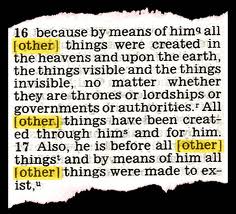
The NWT has been altered to fit what the Watchtower teaches.  This is most obvious when looking at passages dealing with Jesus' deity. Take Colossians as an example.  By inserting the word "other", they have changed the meaning.  

In the NWT Colossians 1:16-17 you can see that the word "other" has been inserted 4 time's.  It is true that it is sometimes necessary to use words not in the original, but surely this is to clarify meaning, not change it.  Read this passage without the word "other".  Now the passage's meaning is the same as it is in every other translation.

Jehovah's Witnesses believe that Jesus is a created being, through whom God created everything else.  Therefore he couldn't create "all things", because he couldn't create himself!  To solve the problem, the Watchtower edited their Bibles.

The Watchtower used to publish the Greek text of the Bible, known as the Kingdom Interlinear Translation.  This made them seem more scholarly - but right there, for all the world to see (or not see in this case!), the word "other" isn't in the Greek.
The Kingdom Interlinear Translation.  Image: CARM
To make matters worse for themselves, they forgot to fully edit John 1:1-3.  They infamously changed John 1:1 to read "a god" rather than "God".  But in verses 2 and 3 we have a parallel passage to Colossians 1:16-20.  In the NWT the passage reads:

"In [the] beginning the Word was, and the Word was with God, and the Word was a god.  This one was in [the] beginning with God.  All things came into existence through him, and apart from him not even one thing came into existence." (emphasis mine)

Oops.  Now their translation of Colossians not only contradicts the Greek text,  it contradicts their own translation.  To make it fit they need to add the word "other" twice here too.  


I don't mind people disagreeing on theology.  If you want to argue that Jesus is not God, fine.  But I do have a problem with blatant dishonesty.  It is dishonest to alter the Bible to fit your beliefs, and then use that to show people "what the Bible really says".  


If the Watchtower can't be trusted on Bible translation, it certainly cannot be trusted with Biblical interpretation.  


Images: Google Images/CARM

[Update May 2014 - See also my article on the 2013 revision of the New World Translation]