Showing posts with label God. Show all posts

Friday, 17 October 2014

Is Jesus the Almighty God?

Image: Google Images

While I was online today, I saw a comment which noted that the Bible never says Jesus is the Almighty God. This position would be supported by Mormons, Jehovah's Witnesses, Muslims and others. But is this true?

No. A short Bible study in the Book of Revelation is very revealing. 

Let's start with Revelation 1:8 (ESV) which says, "I am the Alpha and the Omega,” says the Lord God, “who is and who was and who is to come, the Almighty." So here we have "the Almighty" call himself "the Alpha and the Omega". Alpha and Omega are the first and last letters of the Greek alphabet, which was the language the New Testament was written in. It's akin to saying "I am the A to Z". 

This is not controversial, God, the Almighty claims the title, "Alpha and Omega". However, this title is used 3 times in the Bible, all in the Book of Revelation. So can we gain any more information? Turn to Revelation 22:13-16 (ESV) which says:

"I am the Alpha and the Omega, the first and the last, the beginning and the end. Blessed are those who wash their robes, so that they may have the right to the tree of life and that they may enter the city by the gates. Outside are the dogs and sorcerers and the sexually immoral and murderers and idolaters, and everyone who loves and practices falsehood. I, Jesus, have sent my angel to testify to you about these things for the churches."

Did you notice? The Alpha and Omega identifies himself as Jesus! Only this time, Jesus is not claiming to only be Alpha and Omega, but also the first and the last. This is also a phrase that comes up three times in the Book of Revelation - interesting in a book that is big on symbolism! Can we get any more clarity? 

In Revelation 1:17-18 (ESV) we read, "But he laid his right hand on me, saying, “Fear not,I am the first and the last, and the living one. I died, and behold I am alive forevermore". So now we can be even clearer - the first and last died, and is now alive forevermore. This same point is also emphasised in Revelation 2:8 (ESV).

So, who is the Alpha and Omega? The first and the last, who died and rose again, Jesus Christ - the Almighty Lord God according to Revelation 1:8 (ESV).

Monday, 21 April 2014

Charismatic Christianity

Being open to the Holy Spirit
 is a vital part of being a Christian
I used to identify simply as an Evangelical Christian, but these days I am adding Charismatic to that description.  What does it mean to be Charismatic?

The Charismatic Movement goes back to Easter 1960 when an Episcopal priest related his Pentecostal experience to his congregation.  From there the movement exploded and is now a worldwide phenomenon. 


Charismatics believe that the gifts of the Holy Spirit are for today as well.  This comes from the Bible:


"A spiritual gift is given to each of us so we can help each other. To one person the Spirit gives the ability to give wise advice; to another the same Spirit gives a message of special knowledge. The same Spirit gives great faith to another, and to someone else the one Spirit gives the gift of healing. He gives one person the power to perform miracles, and another the ability to prophesy. He gives someone else the ability to discern whether a message is from the Spirit of God or from another spirit. Still another person is given the ability to speak in unknown languages, while another is given the ability to interpret what is being said. It is the one and only Spirit who distributes all these gifts. He alone decides which gift each person should have." (1 Corinthians 12:7-11)


There was a time when I believed that these gifts had ceased - mainly because I never saw them in the Churches I grew up in.  But I realised that this was the common experience of Christians in the first century. When I came back to Church after reconciling my faith and sexuality, I attended a Church which did believe the gifts were active today.  There I was able to meet people who had experienced the Holy Spirit directly.


In time I experienced this as well.


So, how are Charismatics different to Pentecostals?  The main difference is denomination.  Pentecostal Churches trace their history to the early 20th century whereas the Charismatic Renewal saw Charismatics remaining in their own Churches.  So a Charismatic Christian may be a Baptist, a Methodist, Roman Catholic, or an MCCer.  We share similar beliefs on the Holy Spirit, but retain our Christian traditions.  


Now that Easter is passed, we come to Pentecost in a few weeks.  Why not take time out to seek the Holy Spirit in your life?


Image: Google Images

Sunday, 9 March 2014

Christianity or Islam?

Many people think that Islam and Christianity are just two ways of worshiping the same God.  Yahweh is Allah and Allah is Yahweh.  Is that true?

It is true that Arabic speaking Christians use the word "Allah" for God.  Simply because Allah just means "God".  If we have a man called John Smith, and I tell you that he is married with children you learn something about him.  If someone else tells you John Smith is single with no children, what would you conclude?

We see the same thing when we compare the Bible with the Qur'an.  


[Jesus asked] "why do you call it blasphemy when I say, ‘I am the Son of God’?" (John 10:36)
The Bible says, “but these are written that you may believe that Jesus is the Christ, the Son of God, and that believing you may have life in His name.” (John 20:31).
O People of the Book! Commit no excesses in your religion: Nor say of Allah aught but the truth. Christ Jesus the son of Mary was (no more than) an apostle of Allah, and His Word, which He bestowed on Mary, and a spirit proceeding from Him: so believe in Allah and His apostles. Say not “Trinity” :desist: it will be better for you: for Allah is one Allah. Glory be to Him: (far exalted is He) above having a son. To Him belong all things in the heavens and on earth. And enough is Allah as a Disposer of affairs. (Surah 4:171)
And behold! Allah will say: “O Jesus the son of Mary! Didst thou say unto men, “Worship me and my mother as gods in derogation of Allah”? He will say: “Glory to thee! Never could I say what I had no right (to say). Had I said such a thing, thou wouldst indeed have known it. Thou knowest what is in my heart, though I have not known what is in thine. For thou knowest in full all that is hidden.” (Surah 5:119) 
Jesus clearly says he is the Son of God, the Qur'an denies this.  Both cannot be true.  Notice also, that the claim is that Jesus asked us to worship his mother, which is not Biblical anyway.

So clearly Allah and Jesus are very different - they cannot be the same God.

Furthermore, a cursory reading of the New Testament shows Jesus was crucified, died and was raised from the dead.  The Qur'an denies this:
And because of their saying: We slew the Messiah, Jesus son of Mary, Allah's messenger - they slew him not nor crucified him, but it appeared so unto them; and lo! those who disagree concerning it are in doubt thereof; they have no knowledge thereof save pursuit of a conjecture; they slew him not for certain". (Surah 4:157)
Ancient Jewish and Roman records also record the crucifixion of Jesus, which means the Qur'an stands in opposition to both the Bible and secular history.

Furthermore the Qur'an goes so far as to claim to confirm the Bible.
He sent down to you this scripture, truthfully, confirming all previous scriptures, and He sent down the Torah and the Gospel. (Surah 3:3)
So for the Qur'an to be true, the Bible must be true.  But if the Bible is true, the Qur'an cannot be true. Therefore, whichever way we look at it, Islam is a false religion.  

Image: Google Images

Tuesday, 29 October 2013

The Holy Spirit

For years as a Christian I wondered if "this was it".  Surely there must be "more".  For the last year, God has taken me on a journey, discovering who he is, and who the Holy Spirit is.  This is my summary of what God has been teaching me, and doing with me.

Who is the Holy Spirit?
Simply, the Holy Spirit is God (Acts 5:3-4) living within believers today.  We receive the Holy Spirit when we become Christians (Galatians 3:2).

What does the Holy Spirit do?
In the world, the Spirit convicts us of our sin, and God's righteousness (John 16:8).  In believers He is God's presence within us (John 14:16-17).  He gives us spiritual gifts (1 Corinthians 12:1 and 1 Corinthians 12:7).  These gifts range from tongues to healing and prophecy.

For a long time I was suspicious of the charismatic movement, and still have issues with some of it, namely the "Prosperity Gospel".  But as I studied Scripture I realised that there is a massive difference between the experience of the first Christians, and many of us today.  As I researched my own Church (the Metropolitan Community Church) I found that there is a large charismatic movement within my own denomination as well - this is true of many Churches.  In fact the first Church to recognise the charismatic movement was the Roman Catholic Church.

The more I studied the Bible, the more I realised that there is more!  So I asked God to fill me with the Spirit (some people call it being baptised in the Spirit - don't get hung up on the terminology!).  Nothing happened at first until I was challenged to ask for, and use the gift of tongues.  Well, I wasn't doing that in public!

At home, I prayed again, and I opened my mouth to worship Jesus, and asked the Holy Spirit to speak through me, and sure enough, I did not understand the words coming out of my mouth!

I recently went to see a Christian who has the gift of prophecy.  I do not know her at all, I went on a friend's recommendation.  This is not all about the future, prophecy is being able to hear what God says, and speak it.  She knew about my life, what I prayed as a child, the kind of work I do, as well as what I would not accept as true!  And it wasn't vague, it was specific things only God would have known.

What about you?
Maybe you are wondering if "this is all there is" to the Christian life.  I'm learning that there is more!  I'm stepping out in faith into a new adventure with Jesus, and it's proving to be very exciting.

Image: Google Images

Wednesday, 17 July 2013

Try Praying

It’s the work of a traffic planner, a shop manager, a writer, a designer, an entrepreneur, a civil engineer and others.
A conversation on a train went like this.  The guy in his 20s was asked, “Do you ever pray? “  His reply was, “Yes.  I prayed for two people who were seriously ill.  One died and the other got better.”  He concluded he’d had 50% success.
This reflex – the desire to reach out to God – is basic to many, many people. Trypraying is a resource for people like that: no church connection or interest, but open to find out about God. The trypraying booklet is a 7-day prayer guide and is now being used by many to pass on to friends and family with a few words of encouragement – ‘Why don’t you try praying for a week and see what happens in your life?’  Start at http://www.trypraying.org/start-here/
Image and text: http://www.trypraying.org/

Saturday, 22 June 2013

Prayer

We talk about prayer a lot, but what is it?  How should we pray?  Why should we pray?

Prayer is simply talking with God.  One of the fundamental issues the Bible addresses is our relationship with God.  In John 17:3 Jesus said that to have eternal life meant that we are to know God.  In fact in Matthew 7:23 Jesus says that knowing him will make the difference between saved and unsaved come Judgement Day.

So If relationship with God is that important, how do we build that relationship?  Studying the Bible is obviously important - it's the main way God communicates with us.  But prayer allows us to communicate with God, too.  We can tell God what's on our minds, share our joys and sorrows with him, ask for forgiveness, pray for friends, family and even nations.

Some people pray as if they were presenting a shopping list to God, but I believe we should also listen to what Jesus is saying to us (John 10:16).  The communication needs to run both ways, so make time to listen to God as well.  Another thing we should do is meet with others to pray (Matthew 18:20).  If your partner is a Christian you should regularly pray together.  Keeping God at the centre of your relationship can only make your relationship stronger.

There is another aspect of prayer that I believe is important.  If you have the gift of tongues, you should also pray in tongues as this will also build you up (1 Corinthians 14:4).

Finally, when God is working in your life, talk about it!  Share it, tell others - give God the glory.  In other words, witness to what God is doing in your life.

Images: Google Images

Monday, 6 May 2013

Study Bibles

How do those of us who don't speak Hebrew, Aramaic and Greek access the Bible?  Well, we depend on others to translate the Bible for us.  I have already looked at Bible translations but I wanted to think about Study Bibles.

What is a Study Bible?
A study Bible includes the text of a translation, and usually has the following features:
  • Cross references (which help us find similar passages or parallel verses)
  • Notes (to understand the meaning or context)
  • Maps (so we can see where different events happened)
  • Charts (to piece together the overall picture)
  • Essays (often on the background to books, or on a historical time frame, such as the time between the testaments)
  • Index/Concordance (to help us locate passages on a subject, or verses we know but can't find)
  • More recently, they include online access to an electronic version.
These tools are so useful.  One thing I suggest is that when you buy a Study Bible, get the "personal size" rather than the full size.  The full size ones are heavy, and not easily taken to Bible studies or worship services.  Sometimes this means you lose some content (the NLT Study Bible being an exception to this) but overall it's worth it.  When I was talking with Mormon missionaries I used a full sized study Bible, which was bulky and not so easy to use.  On the ESV Study Bible website, they note that someone joked about a tornado coming - "take cover under your ESV Study Bible"!  Trust me, this is a valid point!  You want a Bible you can hold and use, rather than one you need a desk for!

Because of the useful features, I think every Christian should own at least one Study Bible.

Which Study Bible should I get?
I have 5 study Bibles at the moment, so I thought I would review each, plus the Life Application Study Bible (which I gave away a few years ago).  They all have advantages and disadvantages, but it's worth having a couple - for reasons that will become clear below.

Life Application Study Bible
The Life Application Study Bible is available in every major translation (NIV, NLT, NASB, NKJV etc).  The notes focus on how to apply the Bible in daily life.  I really love some of the essays, but for serious study I wouldn't recommend it.  This is ideal for new Christians though.  The notes are generally Evangelical and like the NIV Study Bible (see below) avoid controversial issues.  One thing I find odd is the Bible text is a single column format, which is only strange because I am used to double columns!

NIV Study Bible
I love the NIV Study Bible.  It has all the standard features of a Study Bible, but one or two drawbacks as well.  On the positive side, the notes provide lots of historical and archaeological background, there's lots of colour, maps - it's visually appealing.  On a negative note, some notes avoid controversial issues and certainly tow the line on many complex issues.  For example, can you lose your salvation?  All the verses which suggest you can are either ignored, or glossed over.  For me, the fact that Christians can, and do, disagree on these areas should be acknowledged and discussed.

If you are a devotee of the NIV (which by all accounts is an excellent translation) then this may be a useful addition to your library.

Fire Study Bible
The Fire Study Bible also uses the NIV, but it's a Pentecostal Study Bible.  While the NIV Study Bible is decidedly Evangelical, it's nice to see a Pentecostal Study Bible.  The notes focus on practical application and on the Holy Spirit, and there is a good deal of historical background too.  I've not used this too much yet, so it's too early to recommend - but so far it's been useful.  Most Study Bibles gloss over the Holy Spirit, so it's nice to have this one for a different "angle".

Chronological Life Application Study Bible
This is a version of the Life Application Study Bible series which uses the NLT.  The notes therefore have the same limitations as the standard Life Application Study Bible.  One drawback is that the Chronological Life Application Study Bible doesn't have the essays in the standard Life Application Study Bible.  There is also the problem of finding a verse!  Because the Biblical text is not in the order we're used to, it's hard to locate verses.  So it's useless to take to Church or Bible Study groups.

What I love about the Chronological Life Application Study Bible is that the Bible text is arranged in chronological order.  This means when you read through the Bible - especially the New Testament - you get a whole new perspective.  When you see how events unfold, some other things make more sense.  One other thing I love is that it's in full colour, uses photos and colour illustrations.  This makes it visually pleasing!

NLT Study Bible
The NLT Study Bible has an Evangelical focus, but unlike the NIV Study Bible, the NLT Study Bible doesn't avoid controversy.  The notes acknowledge where Christians disagree (sadly, not on the homosexuality issue though) and explain each view.  Sadly it isn't in colour so it looks a bit dated compared with others.

The NLT Study Bible seems to attempt to find a middle way between application and background which is great.  As I mentioned, a major "plus" of the personal sized edition is that it doesn't lose any of the content in the size reduction.

ESV Study Bible (Personal Size)
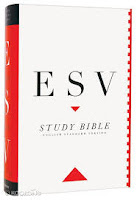
This is my newest addition, and so far I like it.  I've never used the ESV before, but as I am trying to get into more serious study, I value the literal translation of the ESV but wouldn't use it day to day.  It also uses colour maps which is visually appealing, however it has that single column format again.  Picky?  Maybe.  

The ESV itself is a highly regarded translation, and the notes seem to be a balance of application and background.  The essays are informative as well.  Unfortunately the personal size does lose content you find in the full sized version.  It would also have befitted from having a Bible reading plan.

The feel of the ESV Study Bible is quite academic, but that suits me well.  So far I like it, and could see myself investing in a better quality version - I only bought the paperback.  If I use it as much as I think I will, I will invest in a hardback version as this will be more durable.

UPDATE - I ordered a good quality ESV Study Bible, I use it as a reference Bible for study.


The New Spirit Filled Life Bible (NLT)
This is my newest study Bible and I am really enjoying it.  The notes are very helpful, it has a good cross referencing system and helps understanding of key Greek and Hebrew words.  The notes are written from a charismatic perspective, which helps me a lot as this is a new adventure with God for me.  There are also some excellent articles on the Holy Spirit, evangelism, book introductions and so on.

Which one should I get?
As someone once quipped - get the one you will read most!  I would suggest having a couple of Study Bibles.  I will continue using the NIV and NLT Study Bible as I love the translation itself and the study features are well balanced.  I can already see the ESV Study Bible becoming my second Bible to consult, so I would also recommend it.  

If you are a new Christian, get a feel for a translation you like, and get the Life Application Study Bible in that translation.  

I hope this helps - and feel free to share any others you may have!

Images: Google Images, except New Spirit Filled Life Bible which is from wesleyowen.com

Saturday, 13 April 2013

Homosexuality - God's Judgement?

I've been thinking about Romans 1:26-27 again.  I recently read an article which suggested that homosexuality is some kind of punishment from God.  These two verses are the most common verses used from the New Testament to condemn gay and lesbian relationships.  It says:
That is why God abandoned them to their shameful desires. Even the women turned against the natural way to have sex and instead indulged in sex with each other.  And the men, instead of having normal sexual relations with women, burned with lust for each other. Men did shameful things with other men, and as a result of this sin, they suffered within themselves the penalty they deserved.
I've previously discussed this passage and I don't want to repeat that again, I still think the key words here are "lust" and "shameful" - which I struggle to fit into loving gay and lesbian relationships.  I believe that this passage is not a condemnation of loving same-sex relationships, you can read why on this blog.  Instead I want to think about how we would apply this passage if it were talking about God's judgement. 

To see where the idea that homosexuality is God's judgement, it's important to read the whole passage in context - Romans 1:18-32.


Is it judgement?  In context I don't think so.  Verse 26 doesn't say that God gave them shameful and lustful desires, they had these desires already.  Verse 27 doesn't say that the penalty they suffered was inflicted by God.  It could merely be a consequence.  


But for the sake of argument, let's say it is a judgement.  Judgement for what?  Verses 18-25 are all about people who reject the one true God and worship false gods.  About a third of the world's population claims to be Christian.  So, we would expect to see more gay men in countries where Christianity is not the dominant religion. But we don't.  In every culture, about 4% of men are gay and 1% of women are lesbian.  The other problem with this view is people like me.  If being gay is a punishment for rejecting God, how do we explain gay Christians?  And wouldn't we expect to see more gay and lesbian people given that countries like the UK, Australia and the USA are becoming more and more secular?


Maybe the argument would only be that the penalty is the punishment.  Paul's wording is very specific - "they suffered within themselves the penalty they deserved".  The NRSV says, "received in their own persons the due penalty for their error".  So clearly this penalty is something you receive in your person.  What could that be?


Some have said the penalty is HIV/AIDS but I have a couple of problems with that.  Firstly, Paul uses the past tense, people were suffering this 2,000 years ago.  HIV/AIDS is a modern illness, so it cannot be what Paul was talking about.  Secondly, lesbian sex is the safest sex someone can have in terms of STI's.  Given that Paul is talking about women here as well, any STI would not fit because lesbian sex is quite safe.  Heterosexuals and gay men are much more at risk!  Finally, I have a problem with what that would say about God.  I did not choose to be gay, or to fall in love.  Am I to be punished with such a horrible illness because of something I did not choose to be?  What kind of God is that?


So, what's the penalty?  Can I suggest that the rest of this chapter provides the answer?


When a person rejects God, and suppresses their conscience, they lost touch with their Creator, with no moral absolutes there is nothing to guide them.  When a society rejects God, there is no restraint on what is acceptable.  CNN reports what life in North Korea is like at the moment - and we saw similar stories in communist Russia as well. In Muslim countries gay men are subject to heavy penalties for having sex with another man, ranging from flogging, to imprisonment and the death penalty.  


I believe that the penalty "received within themselves" is a change of personality and values. It's the consequences of being actively guided by self rather than the Holy Spirit.  The changes within a person, and their societies, is the penalty deserved.  But that leaves a question.  Isn't this penalty for homosexuals?


No.  The people Paul is talking about are not homosexuals, they are worshipers of false gods who practiced temple prostitution.  This fits what Paul wrote from verse 18 onwards, and what we know of Roman society in Paul's day.


I do not think that anything in Romans 1 condemns gay and lesbian relationships, and I do not believe that we are subject to "special" judgement because we fall in love.


Image: Google Images

Tuesday, 13 November 2012

Can God Cure Gays?

I was recently asked if I believe that God can cure homosexuality.  I am assuming the question meant, can "God make a homosexual, heterosexual?"

Yes.  I believe God can do that - with God all things are possible (Matthew 19:26).

By the same token, I believe that God can make the blind see, the deaf hear and the lame walk!  The question is not "what can God do?"  The question is, "what is God doing?"  And what does this tell us about how God views blind, deaf, lame and gay people?

Lots of research says that ex-gay ministries and reparative therapy does not work.  At best it persuades bisexuals to take opposite sex partners, and teaches homosexuals to suppress their sexuality.  At worst it instills a sense of shame which often results in promiscuity (as that's the only outlet for intimacy with another person when you can't allow yourself to fall in love - second rate, detached, emotionally empty sex).

In his book, "Speaking my Mind", Tony Campolo says that after interviewing hundreds of men who have been through reparative therapy, he is convinced that God is not "curing" homosexuality.

Of course the whole question assumes that there is something to cure.  I've said elsewhere that a Biblical understanding of homosexuality totally negates the question of curing it.  God is not, and has never been bothered by loving, faithful same sex relationships.

Image: Google Images

Monday, 4 June 2012

Trinity Sunday

Last Sunday was Trinity Sunday.  Coming from a Baptist background, a day for the Trinity was a new concept to me.  


Although the Bible never uses the term "Trinity", the concept is clearly taught throughout the Bible.  While it insists that there is only one God, it refers to Jesus, the Father and the Holy Spirit as God.  Each is seen to be a distinct personality, co-existent with each other.  

There is no single verse which explains the Trinity.  However the Bible is fascinating.  For example, in Isaiah we are repeatedly told there is only one saviour - God.  Then in the book of Titus we are given "God our Saviour" and "Christ our Saviour" interchangeably.  And then the statement, "We should live in this evil world with wisdom, righteousness, and devotion to God, while we look forward with hope to that wonderful day when the glory of our great God and Savior, Jesus Christ, will be revealed" (Titus 2:12-13).

Jonathan Sarfati explains:

  • There is only one God (Deuteronomy 6:4, Isaiah 44:8). Note that the Hebrew word for ‘one’ is echad which means composite unity — it is used in Genesis 2:24 where the husband and wife become ‘one flesh’. The word for absolute unity is yachid which is never used of God in the Scripture.
  • The Father is called God (John 6:27, Ephesians 4:6).
  • The Son is called God (Hebrews 1:8. He is also called ‘I am’ in John 8:58 cf. Ex. 3:14 — see below for more biblical proof). He has always existed (John 1:1–3, 8:56–58), but took on full human nature in addition to His divine nature at the Incarnation (John 1:14, Philippians 2:5–11).
  • The Holy Spirit is called God (Acts 5:3–4), and is personal (Acts 13:2), not some impersonal force as the Jehovah’s Witness cult believes.
  • They are distinct, e.g. at the baptism of Jesus in Matthew 3:16–17 all three were present and distinct. The Son is baptized, the Father speaks from Heaven, and the Holy Spirit, in the form of a dove, flies down and lands on the Son. See the baptismal formula in Matthew 28:19 ‘baptizing them in the name of the Father and of the Son and of the Holy Ghost.’ Note that the word ‘name’ is singular, showing that all three Persons are one Being.


The Bible says much more, and there are many great books, and articles online which explain how Christians arrived at this understanding of God, such as the one on CARM which also answers a couple of objections against the Trinity.  It's at http://carm.org/cut-trinity 

While we can never fully understand God, we are invited into a relationship with him, and to be forever changed by knowing him.

Image: Google Images
Reference: http://creation.com/jesus-christ-our-creator-a-biblical-defence-of-the-trinity


Saturday, 17 March 2012

Acceptance

Rev Jeff Bert from the Metropolitan Community Church
joins a vigil for same sex marriage.
Over the last few weeks I have heard religious authorities describe me as (among other things) immoral, intrinsically disordered and sinful.  I have heard my relationship with my partner described as wrong, of no value, and as something that can produce no good spiritual fruit.  We hear pro-marriage groups starting campaign groups with titles such as "...for marriage", as if I'm somehow against marriage!


When we hear prominent religious leaders saying these things, it's hard.  It's painful.  And it makes me angry.  


I know Jesus calls me to love these people, who are my brothers in Christ.  He asks me to accept them - even if they will not love and accept me.  That's a hard teaching.  My human instinct is to react, to fight back.  But God calls us to a higher standard.


I'm praying for marriage equality, and I am asking the Holy Spirit to give me the love to love these men.  

Image: http://www.chicagoreporter.com/news/2010/03/gay-marriage-numbers

Sunday, 18 December 2011

Christmas

It's just 1 week to Christmas, which we're spending with my family this year.  I'm almost finished Christmas shopping, I did almost all of it online!  I'm waiting for one delivery, and I'm collecting a gift tomorrow.  After that I just need to get something for my partner, and I'm trying to work out what he would like.  What do you get someone who isn't overly materialistic?  He already has everything he wants, and we already have too much "stuff"!


All of this got me thinking about how we went about getting gifts sorted.  We set a budget, and divided it up.  And we noticed a pattern - office "secret Santa" got £5.  Nephews and nieces got £20-£30.  Parents got £40-£50.  My partner... don't know yet!


There seems to be a scale of significance in how much we spent.  The more significant the person, the more we spend.  The Secret Santa is one of those annual "must do" things, so the budget is minimal.  Parents get more, nephews and nieces are in between, because they're growing up (and whatever we buy will be out of fashion in six months anyway!).


But Christmas is not really about materialism - or it shouldn't be!  It's about another gift.  2,000 years ago God gave us himself.  What does that tell us about how significant we are to him?  


So, what can give in return?  Romans 12:1 in The Message sums it up:
So here's what I want you to do, God helping you: Take your everyday, ordinary life—your sleeping, eating, going-to-work, and walking-around life—and place it before God as an offering. Embracing what God does for you is the best thing you can do for him. 
And if you'd like a good Christmas song, here's one of my favourites: http://www.youtube.com/watch?v=X2McgKkUChA


This will be my last post of the year, so Merry Christmas, and a Happy New Year.

Image: Google Images

Sunday, 4 September 2011

The Hope Of The Gospel - Alasdair Black


Paul in Colossians exhorts us not to give up on the hope of the gospel. It is easy to give up hope especially when we feel everything is going against us. I remember as a child singing 'Jesus bids us shine' with the words:
Like a little candle
Burning in the night.
In this world of darkness
So let us shine-
You in your small corner,
And I in mine.
The image has always stayed with me - of a child with a candle in a corner surrounded by darkness, hoping Jesus comes back before the darkness gets him or her! But is this really what the hope of the gospel looks like?  Celtic missionaries used to have a very different way of looking at the world. The unseen world that surrounded us was full, not of darkness or foreboding spirits, but the light and glory of God. We were enveloped by the presence and power of the angelic and the saints. In the midst of whatever we were going through the all encompassing light of God surrounded us and dispelled the reality of the darkness.
It is a similar vision that governs Paul's words in Colossians. Paul is affirming a truth that is often forgotten today. The gospel is not dependent on whether I believe in it or not; or whether our society thinks it's true. No, the gospel is a declaration of what has already occurred. It proclaims the difference that the coming of Christ has made to the whole of the created order. It is a declaration of events that have occurred in time and space that have changed the nature of all things. Often in our pluralistic and relativistic age we think all religious truth is simply a matter of what I choose to believe, but Paul wants us to know the gospel is a declaration of how God has transformed the world through the coming of Christ. It is about something that has happened that affects us all whether we choose to believe in it or not.
The first part of the passage is probably a creedal statement used by the early church. It shows us that from the inception of Christianity Jesus is affirmed, not as 'a god', but as the creator God - 'by him all things were created, in heaven and on earth, visible and invisible, whether thrones or dominions or rulers or authorities-all things were created through him and for him. And he is before all things, and in him all things hold together. ' (16-17). Paul wants us to be in no doubt that when Jesus the Creator became part of creation, 'the invisible God' became visible. He uses a phrase 'the first born of all creation' to describe this state of affairs. The phrase is not saying that Jesus is created, but that he is the head of all creation - its author and sustainer. In the same way, Christ is the head of the church.  
But Paul also wants to affirm that the coming of Christ has tangibly changed everything. The gospel is not some ethereal timeless spiritual truth that some people might find helpful; it is declaring an event that has ramifications for us all. God's relationship to the world and to each one of us has changed through the death and resurrection of Jesus. Death is no longer the end and the world is no longer a place full of darkness and alienation. Christ has brought reconciliation, healing and forgiveness. Although it may seem the darkness is winning and power of Christ is waning, Paul exhorts us: 'don't give up the hope of the gospel'. The Christ event has changed everything. The reality of that transformation does not depend on how we feel or how we are doing or even whether we believe in it. It rests on what Christ has done - his birth, death and resurrection. This reality impacts everyone. Let's not lose sight of what Jesus has done, but let others know of the transforming power of God that is at work in the world.


Source: The Hope Of The Gospel - Alasdair Black Senior Pastor, Stirling Baptist Church

Sunday, 17 July 2011

Celibacy

When I was a young Christian I had been taught that gay men ought to be celibate.  There was nothing wrong with being gay or lesbian, but being intimate with another man (or woman) was always sinful.  Many Christians assume that this is a very compassionate view to take.


This view stands in contrast to the position that just being homosexual is sin.  Men and women who buy into that spend vast amounts of time and money on "reparative therapy" to become heterosexual.  I was once subjected to that by a counselor - and it gave me such hope!  Why?


These two views have very different outcomes.  In one I am condemned to life alone, if not condemned for who I am.  The other offers hope that change is possible (as Exodus International is fond of saying).  The obvious problem is that if sexuality is even partly rooted in biology, then it is not possible to change from homosexual to heterosexual.  This makes the Exodus position untenable.  It seems change is possible... to fake.


But someone might ask, can't God cure me?  Of course he can!  I do believe that it is even possible that some gay men have been cured by God - maybe the self loathing and hate was too much for them.  Our God is loving and compassionate.  But the question of cure assumes that there is something to be cured of!  If sexuality is innate then no sexual orientation is sinful - although any deviation from heterosexuality is of course a result of the fall.  But then so is being deaf or blind, and no one argues that being deaf is sinful!


So, if being gay is not a sin - there is only one question to ask.  Is it okay for two gay men who love each other, and commit to each other for life, to live as a married couple, and to express their love in sex?


For this we must turn to the Bible for answers.  There we see no condemnation of gay sex within the context of a loving relationship.  Instead we see that we are to live out our faith in love (Galatians 5:6).  It is better to marry than to burn with lust (1 Corinthians 7:9).  


It took me years to come over to the view I now hold.  I used to passionately defend the view that gay men must be celibate.  But the Holy Spirit is always teaching us new things.


Christians around the world are changing their minds on this issue.  Churches which once would not have thought twice about excommunicating a gay man now ordain partnered gay men.  You see, Christians have been wrong on many things in the past.  Slavery.  Women.  Geocentric-ism.  It's not that the Bible has changed - but the Holy Spirit has shown us that we didn't understand what He meant!


I believe that today, God is doing the same with homosexuality.  


Image: Google Images

Saturday, 2 July 2011

The Long Silence

I first heard this in Church years ago.  I've posted it as interest value though I don't know who wrote it!

The Long Silence

At the end of time, billions of people were seated on a great plain before God's throne. Most shrank back from the brilliant light before them. But some groups near the front talked heatedly, not cringing with cringing shame - but with belligerence. 

"Can God judge us? How can He know about suffering?", snapped a pert young brunette. She ripped open a sleeve to reveal a tattooed number from a Nazi concentration camp. "We endured terror ... beatings ... torture ... death!" 


In another group a Negro boy lowered his collar. "What about this?" he demanded, showing an ugly rope burn. "Lynched, for no crime but being black !" 


In another crowd there was a pregnant schoolgirl with sullen eyes: "Why should I suffer?" she murmured. "It wasn't my fault." 


Far out across the plain were hundreds of such groups. Each had a complaint against God for the evil and suffering He had permitted in His world. How lucky God was to live in Heaven, where all was sweetness and light. Where there was no weeping or fear, no hunger or hatred. What did God know of all that man had been forced to endure in this world? For God leads a pretty sheltered life, they said. 


So each of these groups sent forth their leader, chosen because he had suffered the most. A Jew, a negro, a person from Hiroshima, a horribly deformed arthritic, a thalidomide child. In the center of the vast plain, they consulted with each other. 


At last they were ready to present their case. It was rather clever.Before God could be qualified to be their judge, He must endure what they had endured. Their decision was that God should be sentenced to live on earth as a man. Let him be born a Jew. Let the legitimacy of his birth be doubted. Give him a work so difficult that even his family will think him out of his mind. Let him be betrayed by his closest friends. Let him face false charges, be tried by a prejudiced jury and convicted by a cowardly judge. Let him be tortured.  At the last, let him see what it means to be terribly alone. Then let him die so there can be no doubt he died. Let there be a great host of witnesses to verify it.


As each leader announced his portion of the sentence, loud murmurs of approval went up from the throng of people assembled. 


When the last had finished pronouncing sentence, there was a long silence. No one uttered a word. No one moved. For suddenly, all knew that God had already served His sentence. 

Saturday, 18 June 2011

Sodom and LGB people

This is perhaps the most misunderstood verse in the debate on gay and lesbian relationships.

"...before they retired for the night, all the men of Sodom, young and old, came from all over the city and surrounded the house. They shouted to Lot, “Where are the men who came to spend the night with you? Bring them out to us so we can have sex with them!” (Genesis 19:4-5)

If our question is whether God condemns gay and lesbian relationships, is a verse which is clearly about gang rape relevant? That's right, gang rape - not two men who love each other.

This passage tells us a lot about what God thinks of sexual abuse, but nothing about two gay men who love each other and want to spend their lives together.

Image: Google Images

Saturday, 14 August 2010

Leviticus and LGB People

I'm back after a long and well needed break! I recently was handed a list of Bible verses which are supposed to condemn loving same-sex relationships. I thought I could take each in turn, starting with the one that is most often cited: Leviticus 18:22 and 20:13. They say (NIV):


Do not lie with a man as one lies with a woman; that is detestable.

If a man lies with a man as one lies with a woman, both of them have done what is detestable. They must be put to death; their blood will be on their own heads.
Do these verses apply to us today? If so, what about other verses which say wearing clothes made of mixed fabric is wrong? (Leviticus 19:19)

The key to understanding Leviticus is this: "the law was designed to last only until the coming of the child who was promised" (Galatians 3:19). Leviticus ceased to be applicable with Jesus. Why? Again, the Bible tells us, "no one can be made right with God by trying to keep the law. For the Scriptures say, "It is through faith that a righteous person has life". This way of faith is very different to the way of law which says, "It is through obeying the law that a person has life"." (Galatians 3:11-12).

And here is Paul's bombshell: in Galatians 3:12 he quotes Leviticus 18:5 to show that Leviticus is part of the way of the law - not the way of faith in Jesus. In fact Paul goes on to say that if you think you have to keep one law, you have to keep them all! (Galatians 5:3). He says, "if you are trying to make yourselves right with God by keeping the law, you have been cut off from Christ! You have fallen away from God's grace" (Galatians 5:4).

So, when someone cites Leviticus to me, I remind them that Christians do not live under the Law of Moses. We live under grace, and we do not have to keep these laws.

Image from Google Images

Saturday, 22 May 2010

Book of Mormon - Is it true?

I had the Mormon missionaries round recently. We got to talking about how we know what is true.

The Mormons cited the Book of Mormon:

"And when ye shall receive these things, I would exhort you that ye would ask God, the Eternal Father, in the name of Christ, if these things are not true; and if ye shall ask with a sincere heart, with real intent, having faith in Christ, he will manifest the truth of it unto you, by the power of the Holy Ghost. And by the power of the Holy Ghost ye may know the truth of all things." (Moroni 10:4-5)
And how does the Holy Spirit do this? The answer came from Doctrine and Covenants 9:8-9 (another LDS scripture). It says,

"But, behold, I say unto you, that you must study it out in your mind; then you must ask me if it be right, and if it is right I will cause that your bosom shall burn within you; therefore, you shall feel that it is right. But if it be not right you shall have no such feelings, but you shall have a stupor of thought that shall cause you to forget the thing which is wrong; therefore, you cannot write that which is sacred save it be given you from me".

In other words, if it feels good - it's right. It sounds simple, ask God and He'll make you feel good if it's true. But, then what of people in other religions who feel good about what they believe? Are feelings a good way to test truth claims?

The Bible says

"Look to God’s instructions and teachings! People who contradict his word are completely in the dark." (Isaiah 8:20)

This makes sense; if we are convinced the Bible is true, then we know that those who contradict it cannot be teaching what comes from God. Mormons believe that there are many "gods". God has parents and siblings who are also gods. Yet the Bible says,

"You have been chosen to know me, believe in me, and understand that I alone am God. There is no other God - there never has been, and there never will be." (Isaiah 43:10)

So, according to Isaiah 8:20, where is the Mormon Church on the issue of how many "gods" exist? Isaiah says that it is completely in the dark.

The Book of Mormon also makes an interesting, and testable claim:

"And the angel of the Lord said unto me: Thou hast beheld that the book (the Bible) proceeded forth from the mouth of a Jew; and when it proceeded forth from the mouth of a Jew it contained the fulness of the gospel of the Lord, of whom the twelve apostles bear record; and they bear record according to the truth which is in the Lamb of God. Wherefore, these things go forth from the Jews in purity unto the gentiles, according to the truth which is in God. And after they go forth by the hand of the twelve apostles of the Lamb, from the Jews unto the Gentiles, thou seest the formation of that great and abominable church, which is most abominable above all other churches; for behold, they have taken away from the gospel of the Lamb many parts which are plain and most precious; and also many covenants of the Lord have they taken away." (1 Nephi 13:24-26)
The claim is that the Bible has been deliberately corrupted by the early Church resulting in the loss of "plain and most precious" things. This means that we need a restoration of the truth - which is where the LDS scriptures come in. Without that corruption everything the Mormon believes is meaningless. So is it true? The Book of Mormon footnotes claim this was first written around 600-592 BC. Leaving aside the fact that there is no evidence to support the Book of Mormon's existence prior to the 19th century, we can test this claim. And the Bible says we should. It asks an important question:

"How will we know whether or not a prophecy is from the Lord?" (Deuteronomy 18:21)

Good question! The next verse answers the question:

"If the prophet speaks in the Lord’s name but his prediction does not happen or come true, you will know that the Lord did not give that message." (Deuteronomy 18:22)
This is genious - it's so simple and it confounds self-fulfilling prophecy! So, if Nephi is a false prophet there may be some of his predictions which would not come true. And this is one of them! We know from the Dead Sea Scrolls and over 40,000 manuscripts for the New Testament, that the Bible has not been changed.

Conclusion: Mormonism fails the tests of doctrine, factual accuracy, and the test of a prophet. Doctrinally it contradicts what God has already said. It has no historical basis before the 19th century. Even if it did, the Book of Mormon fails the test of a prophet. Mormonism is therefore not from God.

Friday, 19 March 2010

Westboro

"These people honor me with their lips, but their hearts are far from me.
Their worship is a farce, for they teach man-made ideas as commands from God"
(Jesus in Mark 7:6-7).

You've probably heard of Westboro "Baptist" Church. They're well known for their outrageous protests. Their main target has been gay men and American soldiers. They claim to be teaching the word of God - but are they?

Who are Westboro?
Westboro "Baptist" Church consists of less than 100 people, most of them from the Phelps family. The patriarch of the family is the Church's pastor. They have been listed as a cult by the Apologetics Index site http://www.apologeticsindex.org/111-westboro-baptist-church.

Are they Baptists?
The problem is that Baptists have no central authority, so anyone can use the name Baptist. So if you just go by the name, yes, they are. But Westboro isn't linked with any Baptist Union, and in fact they have been condemned by Baptists all over the world. In England the Baptist Union said this:

"We do not share their hatred of lesbian and gay people. We believe that God loves all, irrespective of sexual orientation, and we unreservedly stand against their message of hate toward those communities. Neither the style nor substance of their preaching expresses the historic, orthodox Christian faith. And we ask that the members of Westboro Baptist Church refrain from stirring up any more homophobic hatred..." http://www.baptist.org.uk/news_media/latest_news/gay_play.html


So, there you have it - they go so far as to say Westboro does not represent the true Christian faith! Could you get a stronger condemnation? They're not Baptists in any meaningful sense of the word.

With that in mind, in future this site will refer to them as the "Westboro Church".

Is what they're teaching Biblical?
Let's compare some of what the Westboro Church says with the Bible. Westboro says:

"Our message to this evil world is that God hates you, and you better prepare for the return of Christ in power and glory. Jesus came the first time to save; and Jesus will come the second time in vengeance, because you do not obey the Gospel. It will be soon, and you will experience the wrath of the Lamb, face to face." http://www.godhatestheworld.com/common/html/john316.html


That's the essence of what they teach. Whoever you are, God hates you. But what does the Bible have to say? Consider the most famous verse in the Bible, and the following verse!

"God loved the world so much that he gave his one and only Son, so that everyone who believes in him will not perish but have eternal life. God sent his Son into the world not to judge the world, but to save the world through him." (John 3:16-17)
How does that fit with what Westboro teaches? They have had to come up with a complicated justification for rejecting what this verse so obviously teaches. So, Westboro says their message is that God hates you. The Bible says God loves you. Who will you believe?

Anyone who hates you, or tells you that God hates you does not know God. The Bible says, "anyone who does not love does not know God, for God is love" (1 John 4:8).

How should we respond?
"Don’t repay evil for evil. Don’t retaliate with insults when people insult you. Instead, pay them back with a blessing. That is what God has called you to do, and he will bless you for it" (1 Peter 3:9). That's a hard teaching, but the measure of our love is not how much we love those it's easy to love. No, the measure of our love is how well we love those it's hardest to love, like those people at the Westboro Church.

Image from: http://www.godhatesfags.com/visual/photos/multisigns.jpg