Tuesday, 29 October 2013

The Holy Spirit

For years as a Christian I wondered if "this was it".  Surely there must be "more".  For the last year, God has taken me on a journey, discovering who he is, and who the Holy Spirit is.  This is my summary of what God has been teaching me, and doing with me.

Who is the Holy Spirit?
Simply, the Holy Spirit is God (Acts 5:3-4) living within believers today.  We receive the Holy Spirit when we become Christians (Galatians 3:2).

What does the Holy Spirit do?
In the world, the Spirit convicts us of our sin, and God's righteousness (John 16:8).  In believers He is God's presence within us (John 14:16-17).  He gives us spiritual gifts (1 Corinthians 12:1 and 1 Corinthians 12:7).  These gifts range from tongues to healing and prophecy.

For a long time I was suspicious of the charismatic movement, and still have issues with some of it, namely the "Prosperity Gospel".  But as I studied Scripture I realised that there is a massive difference between the experience of the first Christians, and many of us today.  As I researched my own Church (the Metropolitan Community Church) I found that there is a large charismatic movement within my own denomination as well - this is true of many Churches.  In fact the first Church to recognise the charismatic movement was the Roman Catholic Church.

The more I studied the Bible, the more I realised that there is more!  So I asked God to fill me with the Spirit (some people call it being baptised in the Spirit - don't get hung up on the terminology!).  Nothing happened at first until I was challenged to ask for, and use the gift of tongues.  Well, I wasn't doing that in public!

At home, I prayed again, and I opened my mouth to worship Jesus, and asked the Holy Spirit to speak through me, and sure enough, I did not understand the words coming out of my mouth!

I recently went to see a Christian who has the gift of prophecy.  I do not know her at all, I went on a friend's recommendation.  This is not all about the future, prophecy is being able to hear what God says, and speak it.  She knew about my life, what I prayed as a child, the kind of work I do, as well as what I would not accept as true!  And it wasn't vague, it was specific things only God would have known.

What about you?
Maybe you are wondering if "this is all there is" to the Christian life.  I'm learning that there is more!  I'm stepping out in faith into a new adventure with Jesus, and it's proving to be very exciting.

Image: Google Images

Wednesday, 9 October 2013

New New World Translation

The Watchtower Bible and Tract Society (Jehovah's Witnesses) have released a revision of the New World Translation.  I'll refer to it as the NWT2013. 

I've previously written about the JW "Bible", but this new edition calls for a review.  As I've only recently downloaded it, this post will be a work in progress (check last update date below).

The first thing I notice is the additional articles and book introductions in the NWT2013, which reminds me of the Gideon Bibles we were given at school.  One of the most surprising things is that this new edition neatly co-incides with the doctrinal change over the year 1914.  In fact, on p1767 (in the PDF) 1914 becomes "About 1914".  They are obviously moving away from such a strong emphasis.  They used to teach that the world would end before the generation alive in 1914 died out.  As 2014 marks 100 years since 1914, this is obviously looking to become another false prophecy.  So, they're sidelining it now.
NWT2013 - brackets gone!

The text of the NWT has also been altered.  In my last article on the NWT1984 I commented on use of square brackets in Colossians 1 and how misleading it is to add the word "other", even in brackets.  In the NWT2013 the brackets have disappeared completely.

If you can, get your hands on the Kingdom Interlinear Translation (KIT) which was published by the Watchtower - it clearly shows that the word "other" is not in the text.  (The book is hard to come by, however it is available on the JW app)  The NWT2013 has gone to extreme lengths to hide the obvious teaching that Jesus is in fact God.

Having said that, there has also been a substantial change (or admission?) on John 1:1.  The main text reads as it did in the 1984 edition.  However, the Watchtower has always argued that it should never be translated as "the Word was God", and barely conceded that "divine" was correct.  However in the NWT2013 there is a footnote to John 1:1.  It acknowledges that "divine" is possible.

Of course, any world-class Bible scholar will still tell you that John 1:1 should read, "the Word was God". 

There does seem to be more in the line of alternate translations in the footnotes, which can only be an attempt to make the NWT2013 seem more scholarly. 

On a more positive note, John 17:3 has now been translated correctly with the incorrect translation relegated to a footnote.  But I wonder how many "rank and file" JW's expect a real relationship with God? 

One other interesting thing to note is that the 2013 edition is much easier to read.  Comparing verses with the NIV and ESV, I would say it's like reading a combination of them - in fact a few of the verses are rendered the same way as the ESV which suggests it was used as source material (or perhaps the RSV or NRSV which are the same "family" of translations as the ESV).  

The NWT2013 is as deceptive (or more in some places) as its predecessors as a translation of the Bible.  It is still to be avoided as a Bible for any serious student of the Scriptures.  

Last update: 13 May 2014

Images: Google Images, screen shots of my PDF copy
Source: http://www.jw.org/en/jehovahs-witnesses/faq/new-world-translation-accurate/ (Accessed May 2014)

Wednesday, 17 July 2013

Try Praying

It’s the work of a traffic planner, a shop manager, a writer, a designer, an entrepreneur, a civil engineer and others.
A conversation on a train went like this.  The guy in his 20s was asked, “Do you ever pray? “  His reply was, “Yes.  I prayed for two people who were seriously ill.  One died and the other got better.”  He concluded he’d had 50% success.
This reflex – the desire to reach out to God – is basic to many, many people. Trypraying is a resource for people like that: no church connection or interest, but open to find out about God. The trypraying booklet is a 7-day prayer guide and is now being used by many to pass on to friends and family with a few words of encouragement – ‘Why don’t you try praying for a week and see what happens in your life?’  Start at http://www.trypraying.org/start-here/
Image and text: http://www.trypraying.org/

Thursday, 11 July 2013

Jehovah's Witnesses - challenge accepted!

I met the Jehovah's Witnesses today, and they gave me a copy of the Watchtower magazine.  On page 7 a challenge was issued.  It is this:  "The next time you meet Jehovah’s Witnesses, why not ask them why they trust their religion? Examine their teachings and their record."

Okay, let's do that:


  1. They predicted the end of the world in 1914 (later changed), 1925 and 1975 (to name a few).  
  2. They are as guilty as certain other religious organisations on child abuse and cover-ups.
  3. They do not believe historic Christian teachings on the Trinity, the soul, salvation or eternity (to name a few).  Their beliefs contradict the Bible.
  4. They mistranslated the Bible, and published it as the New World Translation - so that they have a Bible that fits their beliefs.
  5. A "Bible study" turns out to be a study of a Watchtower book, rather than the Bible.
  6. Their organisation bans "independent thinking", encouraging complete obedience to the Watchtower Society.  Members are not allowed to read books critical of JW teachings.
So their teachings and record show that they are not the true Christian faith they make themselves out to be, but are in fact a cult based on Christianity.

If you are thinking about studying with the Jehovah's Witnesses, by all means, "Examine their teachings and their record."

Image: Google Images

Saturday, 22 June 2013

Prayer

We talk about prayer a lot, but what is it?  How should we pray?  Why should we pray?

Prayer is simply talking with God.  One of the fundamental issues the Bible addresses is our relationship with God.  In John 17:3 Jesus said that to have eternal life meant that we are to know God.  In fact in Matthew 7:23 Jesus says that knowing him will make the difference between saved and unsaved come Judgement Day.

So If relationship with God is that important, how do we build that relationship?  Studying the Bible is obviously important - it's the main way God communicates with us.  But prayer allows us to communicate with God, too.  We can tell God what's on our minds, share our joys and sorrows with him, ask for forgiveness, pray for friends, family and even nations.

Some people pray as if they were presenting a shopping list to God, but I believe we should also listen to what Jesus is saying to us (John 10:16).  The communication needs to run both ways, so make time to listen to God as well.  Another thing we should do is meet with others to pray (Matthew 18:20).  If your partner is a Christian you should regularly pray together.  Keeping God at the centre of your relationship can only make your relationship stronger.

There is another aspect of prayer that I believe is important.  If you have the gift of tongues, you should also pray in tongues as this will also build you up (1 Corinthians 14:4).

Finally, when God is working in your life, talk about it!  Share it, tell others - give God the glory.  In other words, witness to what God is doing in your life.

Images: Google Images

Monday, 6 May 2013

Study Bibles

How do those of us who don't speak Hebrew, Aramaic and Greek access the Bible?  Well, we depend on others to translate the Bible for us.  I have already looked at Bible translations but I wanted to think about Study Bibles.

What is a Study Bible?
A study Bible includes the text of a translation, and usually has the following features:
  • Cross references (which help us find similar passages or parallel verses)
  • Notes (to understand the meaning or context)
  • Maps (so we can see where different events happened)
  • Charts (to piece together the overall picture)
  • Essays (often on the background to books, or on a historical time frame, such as the time between the testaments)
  • Index/Concordance (to help us locate passages on a subject, or verses we know but can't find)
  • More recently, they include online access to an electronic version.
These tools are so useful.  One thing I suggest is that when you buy a Study Bible, get the "personal size" rather than the full size.  The full size ones are heavy, and not easily taken to Bible studies or worship services.  Sometimes this means you lose some content (the NLT Study Bible being an exception to this) but overall it's worth it.  When I was talking with Mormon missionaries I used a full sized study Bible, which was bulky and not so easy to use.  On the ESV Study Bible website, they note that someone joked about a tornado coming - "take cover under your ESV Study Bible"!  Trust me, this is a valid point!  You want a Bible you can hold and use, rather than one you need a desk for!

Because of the useful features, I think every Christian should own at least one Study Bible.

Which Study Bible should I get?
I have 5 study Bibles at the moment, so I thought I would review each, plus the Life Application Study Bible (which I gave away a few years ago).  They all have advantages and disadvantages, but it's worth having a couple - for reasons that will become clear below.

Life Application Study Bible
The Life Application Study Bible is available in every major translation (NIV, NLT, NASB, NKJV etc).  The notes focus on how to apply the Bible in daily life.  I really love some of the essays, but for serious study I wouldn't recommend it.  This is ideal for new Christians though.  The notes are generally Evangelical and like the NIV Study Bible (see below) avoid controversial issues.  One thing I find odd is the Bible text is a single column format, which is only strange because I am used to double columns!

NIV Study Bible
I love the NIV Study Bible.  It has all the standard features of a Study Bible, but one or two drawbacks as well.  On the positive side, the notes provide lots of historical and archaeological background, there's lots of colour, maps - it's visually appealing.  On a negative note, some notes avoid controversial issues and certainly tow the line on many complex issues.  For example, can you lose your salvation?  All the verses which suggest you can are either ignored, or glossed over.  For me, the fact that Christians can, and do, disagree on these areas should be acknowledged and discussed.

If you are a devotee of the NIV (which by all accounts is an excellent translation) then this may be a useful addition to your library.

Fire Study Bible
The Fire Study Bible also uses the NIV, but it's a Pentecostal Study Bible.  While the NIV Study Bible is decidedly Evangelical, it's nice to see a Pentecostal Study Bible.  The notes focus on practical application and on the Holy Spirit, and there is a good deal of historical background too.  I've not used this too much yet, so it's too early to recommend - but so far it's been useful.  Most Study Bibles gloss over the Holy Spirit, so it's nice to have this one for a different "angle".

Chronological Life Application Study Bible
This is a version of the Life Application Study Bible series which uses the NLT.  The notes therefore have the same limitations as the standard Life Application Study Bible.  One drawback is that the Chronological Life Application Study Bible doesn't have the essays in the standard Life Application Study Bible.  There is also the problem of finding a verse!  Because the Biblical text is not in the order we're used to, it's hard to locate verses.  So it's useless to take to Church or Bible Study groups.

What I love about the Chronological Life Application Study Bible is that the Bible text is arranged in chronological order.  This means when you read through the Bible - especially the New Testament - you get a whole new perspective.  When you see how events unfold, some other things make more sense.  One other thing I love is that it's in full colour, uses photos and colour illustrations.  This makes it visually pleasing!

NLT Study Bible
The NLT Study Bible has an Evangelical focus, but unlike the NIV Study Bible, the NLT Study Bible doesn't avoid controversy.  The notes acknowledge where Christians disagree (sadly, not on the homosexuality issue though) and explain each view.  Sadly it isn't in colour so it looks a bit dated compared with others.

The NLT Study Bible seems to attempt to find a middle way between application and background which is great.  As I mentioned, a major "plus" of the personal sized edition is that it doesn't lose any of the content in the size reduction.

ESV Study Bible (Personal Size)
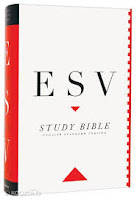
This is my newest addition, and so far I like it.  I've never used the ESV before, but as I am trying to get into more serious study, I value the literal translation of the ESV but wouldn't use it day to day.  It also uses colour maps which is visually appealing, however it has that single column format again.  Picky?  Maybe.  

The ESV itself is a highly regarded translation, and the notes seem to be a balance of application and background.  The essays are informative as well.  Unfortunately the personal size does lose content you find in the full sized version.  It would also have befitted from having a Bible reading plan.

The feel of the ESV Study Bible is quite academic, but that suits me well.  So far I like it, and could see myself investing in a better quality version - I only bought the paperback.  If I use it as much as I think I will, I will invest in a hardback version as this will be more durable.

UPDATE - I ordered a good quality ESV Study Bible, I use it as a reference Bible for study.
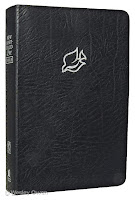

The New Spirit Filled Life Bible (NLT)
This is my newest study Bible and I am really enjoying it.  The notes are very helpful, it has a good cross referencing system and helps understanding of key Greek and Hebrew words.  The notes are written from a charismatic perspective, which helps me a lot as this is a new adventure with God for me.  There are also some excellent articles on the Holy Spirit, evangelism, book introductions and so on.

Which one should I get?
As someone once quipped - get the one you will read most!  I would suggest having a couple of Study Bibles.  I will continue using the NIV and NLT Study Bible as I love the translation itself and the study features are well balanced.  I can already see the ESV Study Bible becoming my second Bible to consult, so I would also recommend it.  

If you are a new Christian, get a feel for a translation you like, and get the Life Application Study Bible in that translation.  

I hope this helps - and feel free to share any others you may have!

Images: Google Images, except New Spirit Filled Life Bible which is from wesleyowen.com

Friday, 3 May 2013

New Functionality

I've added RefTagger to this site so that when you hover over a Bible verse I quote, you can read it yourself!  Just hover over a Bible verse and it should pop up!  Try John 3:16.

I hope that this will help you save time looking up verses, or if you don't have your Bible to hand. However, I would encourage you to still use your Bible - you should always read verses quoted in context.  You can always explore more at sites such as Biblegateway - and I have a lookup box on the right so you can easily look up passages there.

When I was testing it, I found that RefTagger didn't work too well with the new design, so I've reverted back to the "old" design.  If you see any broken links as a result, please let me know.

As before I am using my preferred translation, the New Living Translation.