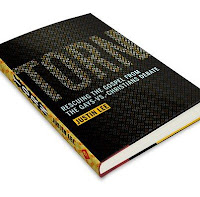
 I just read "Torn: Rescuing the Gospel from the Gays-vs -Christians Debate" by GCN's Justin Lee (released as "Unconditional: Rescuing the Gospel from the Gays Vs Christians Debate" in the UK).
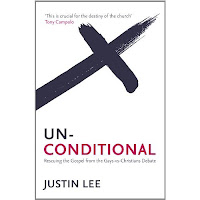
This is a great book in which Justin shares his own story. While he does explain why he believes that the Bible does not condemn gay and lesbian relationships, the focus is on a better way for Christians to relate to one another. Rather than arguing, he says we need to learn to listen to each other, to learn from each other and love each other.
I loved this book - it's personal, it's Justin's life story. He shares his heartaches, joys, and faith. It's Biblical - Justin never lets go of the centrality of Jesus and the Bible. It's relational, Justin shares some of the stories of people he has met along the way.
I think this book is a refreshing change to books about gay debate. Instead of just arguing for one side (which he does do!), it's less about proving a point of view, and more about how to live together.
I recommend this book to everyone who is interested in the Bible and gay people. If you are gay you'll probably recognise much of yourself in Justin's story. If you know someone who is gay and Christian, you'll gain valuable insight into our lives.
You can find out more at http://www.tornbook.com/ - and it's even available on Kindle!
Images: Google Images
I've been doing some interesting reading on Bible prophecies lately. I wondered if anyone had any ideas on these 2 areas...
The Antichrist - a Muslim?
I was always taught that the antichrist would be a European, and most likely an atheist/humanist. This is based on Daniel 9:26 (NIV) since the people who destroyed the Temple after the Messiah were the Romans.
However, research suggests that the armies who had Jerusalem under siege were not ethnic Romans, they were mostly from Syria, Egypt and that area - specifically Arabs and Syrians. The word "people" (Heb = am) in "people of the ruler will come" designates ethnic, not national identity. There is also an interesting passage in Micah 5 which says that "Assyrians" will invade, and be defeated by Jesus Christ Himself. This is interesting given that Christians believe that the Antichrist will invade Israel and will be defeated by Jesus at the Second Coming.
Furthermore, Muslims (largely Shia, but Sunnis also believe this) are awaiting a leader known as Al Mahdi (Lit "The Guided One). He is an interesting character. Most sources have him coming from Iran, to destroy Israel, to unite Muslims politically into a new Caliphate, convert all people to Islam and will in effect persecute Jews and Christians who don't convert. He will rule for 7 years (some sources say longer, 7 is the majority view) and is identified as a rider on a white horse - some Muslim scholars say they see Al Mahdi in Revelation 6:2.
This is an amazing mirror image of the Biblical Antichrist - ironically that's who the rider on the white horse in Revelation 6:2 is! In the Bible the Antichrist is a military leader, who has an empire, calls people to one religion, persecutes Jews and Christians and has a 7 year treaty with Israel (which he will break half way through).
Here's another thing - Al Mahdi warns that the Dajjal (the Islamic Antichrist) will appear, defend Jerusalem with the Jews, and will persuade them that he is Jesus the Messiah. Muslims are warned to flee from him and ignore everything he says. Interestingly the Bible says Jesus will defend Jerusalem, and will convince many Jews of who he truly is.
The Rapture - When?
I was always taught that there will be a rapture of God's people just before the 7 year Tribulation. I've been looking at this again, and am less and less convinced that this is what the Bible is teaching. There is no clear verse which says Jesus will have a 2-stage return. Historically Christians have not believed in a rapture that precedes the Second Coming - they have always been seen as the same event. Jesus gathers his people to himself at the Second Coming.
I've been thinking about what the effects of the belief in a pre-trib rapture would mean. I think it leaves Christians unprepared for the suffering that is coming. Corrie Ten Boom said that she believes that the pre-trib rapture is a false teaching, and ignores the tribulation that 60% of the Church is already experiencing, and leaves us unprepared for the horrors that are coming. She has a point.
If you have read up on any of this, and have any thoughts, please let me know what you think - this is a very interesting area of Bible Study!
Image: Google Images
It's almost the end of 2012, and it's almost 2013! The world didn't end on December 21st (in case you hadn't noticed!) but nevertheless, we are a year closer to Heaven.
Whatever your 2012 has been, I pray your 2013 will be a great year! Make every day of 2013 count.
God bless, and Happy New Year!
I was recently asked if I believe that God can cure homosexuality. I am assuming the question meant, can "God make a homosexual, heterosexual?"
Yes. I believe God can do that - with God all things are possible (Matthew 19:26).
By the same token, I believe that God can make the blind see, the deaf hear and the lame walk! The question is not "what can God do?" The question is, "what is God doing?" And what does this tell us about how God views blind, deaf, lame and gay people?
Lots of research says that ex-gay ministries and reparative therapy does not work. At best it persuades bisexuals to take opposite sex partners, and teaches homosexuals to suppress their sexuality. At worst it instills a sense of shame which often results in promiscuity (as that's the only outlet for intimacy with another person when you can't allow yourself to fall in love - second rate, detached, emotionally empty sex).
In his book, "Speaking my Mind", Tony Campolo says that after interviewing hundreds of men who have been through reparative therapy, he is convinced that God is not "curing" homosexuality.
Of course the whole question assumes that there is something to cure. I've said elsewhere that a Biblical understanding of homosexuality totally negates the question of curing it. God is not, and has never been bothered by loving, faithful same sex relationships.
Image: Google Images
At the Mormon Church's General Conference in October 2012, Elder Robert D. Hales (I'll call him Robert as this is easier, though no disrespect is intended) gave a talk at which he outlined a couple of key Mormon beliefs.
He then asked if there can be any doubt Mormons are Christian.
After reading what he said, I think the answer is clear - there can be doubt. Here is what he said:
What does it mean to be a Christian?
A Christian has faith in the Lord Jesus Christ, that He is the literal Son of God, sent by His Father to suffer for our sins in the supreme act of love we know as the Atonement.
A Christian believes that through the grace of God the Father and His Son, Jesus Christ, we can repent, forgive others, keep the commandments, and inherit eternal life.
The word Christian denotes taking upon us the name of Christ. We do this by being baptized and receiving the gift of the Holy Ghost by the laying on of hands by those holding His priesthood authority.
A Christian knows that throughout the ages, God’s prophets have always testified of Jesus Christ. This same Jesus, accompanied by Heavenly Father, appeared to the Prophet Joseph Smith in the year 1820 and restored the gospel and the organization of His original Church.
Through the scriptures and the witness of Joseph Smith, we know that God, our Heavenly Father, has a glorified and perfected body of flesh and bone. Jesus Christ is His Only Begotten Son in the flesh. The Holy Ghost is a personage of spirit whose work is to testify of the Father and the Son. The Godhead is three separate and distinct beings, unified in purpose.
With these doctrines as the foundation of our faith, can there be any doubt or disputation that we, as members of The Church of Jesus Christ of Latter-day Saints, are Christian?
Where do I start?!
Robert starts out well, Christians do indeed have faith in Jesus. From here, I have issues. When a Mormon says Jesus is the literal Son of God, they do mean literal - God had sex with his wife and she gave birth to Jesus. And Satan, and you and me. Is this Christian?
A Christian certainly believes in grace, repentance etc. But do we inherit eternal life by obeying commandments? No. That's not what the Bible teaches in Ephesians 2:8. We inherit eternal life (indeed inherit anything) because someone - Jesus - died for us. We obey God out of love, not to get something.
Do we receive the Holy Spirit through the laying on of hands by someone with "priesthood authority"? No. We receive the Holy Spirit by believing in Jesus. (Galatians 3:2)
Do we believe that Joseph Smith was a prophet? Hardly (see my other articles on the Book of Mormon for why).
Do we believe that the Father has a body of flesh and bone? No! (John 4:24) Do we believe that the Godhead is merely unified in purpose? No. (See article on the Trinity)
Revisiting Robert's question then, "With these doctrines as the foundation of [their] faith, can there be any doubt or disputation that ...members of The Church of Jesus Christ of Latter-day Saints, are Christian?" Erm... Yes! Sociologists may say they are Christian, but Mormons are definitely not Christians in any biblical sense of the word "Christian".
Image: Google Images
Source: http://www.lds.org/general-conference/2012/10/being-a-more-christian-christian?lang=eng
The talk also appeared in the November 2012 edition of the Ensign Magazine, published by the Mormon Church.
Update!
I have added Google Translate to my site - so if English isn't your first language, I hope this helps!
:-)
The Bible has been used to oppress, enslave, judge and condemn many people over the last 2,000 years. But it has also inspired Mother Theresa, William Wilberforce, Martin Luther King, Jnr., Desmond Tutu and many others to amazing sacrifices in the name of equality and human rights.
To some, the Bible is a list of rules and contradictions. To others, like me, it's a book which liberates and sets us free - and introduces us to Jesus!
How can one book be read in such different ways - and which is right? How can we read and interpret the Bible correctly?
The Book of Books
The Bible is a collection of 66 books. 39 make up the Old Testament (which is the same as the Jewish Bible, albeit in a different order) and 27 books make up the New Testament. The Bible contains many kinds of writing, such as historical narrative (e.g. the Gospels), poetry (the Psalms), Jewish law codes (Leviticus), and apocalyptic literature (i.e. symbolic writings such as Revelation). Being aware of the genre you are reading will help you understand and apply the Bible. It's often mentioned that the Bible contains outrageous statements, for example, it says something about dashing children against the rocks. This comes from Psalm 137 - a song of lament for Israel's situation. They had been taken into captivity by the Babylonians and the writer is obviously angry. When we read this as poetry, in its context it's impossible to read this as God sanctioning actually dashing someone's child against a rock!
Not written in English
The Bible was written in Hebrew, Aramaic and Greek - which means most of us rely on translations into our own languages. It's important to choose a good, yet readable translation for your main study. It is worth comparing several translations to get closer to the original texts. One of the verses used to say gay and lesbian relationships are wrong comes from 1 Corinthians 6:9-10 and 1 Timothy 1:9-10. The word is ambiguous in the Greek, but you'd never know that using many English translations. Comparing several reveals a difference in opinion, and you can then target your research to get a deeper understanding of the text.
Written in another time and culture
This point seems obvious, but it affects how we read the Bible. The Bible was written to show us the way to God, not to answer every question we may have. We need to be aware of Biblical cultural issues as this will help us understand what we are reading. A good study Bible will help with this.
Letting the Bible explain itself
Sometimes we come across a verse we just don't understand. It helps to look up other Scriptures on the same topic - many Bibles come with a concordance at the back (a bit like an index) which can help. If you are using a study Bible it will likely have cross references which can help you interpret the verse. You can also get a Thompson Chain Reference Bible which links topics and themes together so you can "trace" them through the Bible.
Noting the Church
It is only in recent times that we have our own personal copies of the Bible. For almost all of Jewish and Christian history you had to go the Synagogue or Church to hear Scripture. Biblical interpretation was a community effort, so many of our questions have been looked at in the Christian community already. So it's worth looking into what other Christians have said about a passage before. It's likely that at some point, someone asked the same question over the last 2,000 years! This does not exclude new understandings of Scripture (as we've done with women, slavery, homosexuality etc) but we should be very cautious of anything that conflicts with key doctrines (the authority of Scripture, God, the Trinity, Jesus' death and resurrection, salvation by grace through faith alone, etc). I'd ignore anyone contradicting any of these.
Dealing with "contradictions"
I put contradictions in quote marks because I have yet to see an actual contradiction in the Bible. Remember what a contradiction is. It's two statements that cannot both be true at the same time. If I come in to Church and tell you I met Greg outside, and then tell someone else I met Sarah, am I contradicting myself? No. I am presenting an inconsistency, but not a contradiction. Why? It's possible I met both of them outside. If I said there was no one but Greg outside, then telling someone I met Sarah is obviously a problem.
The Bible is much the same, every "contradiction" I've ever been shown turns out to be an inconsistency - which actually bolsters the credibility of the Bible. If we had 4 identical Gospels, people would rightly argue that the writers were getting their story straight before they wrote. But the fact that they feel free to write something that is an inconsistency lends support to them being honest witnesses.
One last thing with contradictions. Every person who tries to show me a contradiction always uses an English Bible. The problem is that it's a translation! When you go back to Greek you see that it isn't. For example, in 2 of Paul's conversion accounts, we read that his companions heard the heavenly voice in one, and they did not hear it in the other. In English this is a contradiction. In Greek however it isn't. In one, the word means to hear something audibly. The other means to hear, as in comprehend. Put the two together and you have the companions hearing a voice but not being able to understand it. There is no contradiction after all.
Where to begin?
If you are new to the Bible, start with a Gospel, then maybe Romans and Galatians. You can also get Bible reading notes to help you read a little every day, or you can be ambitious and use a reading plan to read the Bible in a year! The best ones mix up an Old Testament reading, a New Testament reading, and a Psalm or Proverb, which keeps it interesting (especially when you get to "begats"!).
And the key thing!
The Bible was inspired by God, so we should ask for His help in understanding it. Regular reading is important as well, as you read you'll be drawn into a divine conversation. It's amazing how often we bring our questions to the Bible, and end up being "questioned" by it!
Finally...
I've said before, the Bible is like a billboard advertising ice cream. You can spend a lot of time looking at the billboard, dissecting the colours, fonts, meanings and so on. But if you never actually go and get the ice cream, you missed the whole point. The same is true for the Bible. Jesus once said, "You search the Scriptures because you think they give you eternal life, but the Scriptures point to me!" (John 5:39 NLT) So don't just read the Bible, get to know Jesus for yourself!
Image: Google Images
UPDATED NOVEMBER 2017
 I just read "Torn: Rescuing the Gospel from the Gays-vs -Christians Debate" by GCN's Justin Lee (released as "Unconditional: Rescuing the Gospel from the Gays Vs Christians Debate" in the UK).